The Silent Whisper: Why Your Bearded Dragon Keeps Waving at the Glass
- Quick Tags: Bearded Dragon Behavior, Reptile Social Signals, Exotic Pet Care, Bearded Dragon Stress Signs
- Editor: Chloe Jones
- Updated: Jun,06,2026
- Views: 350.3k









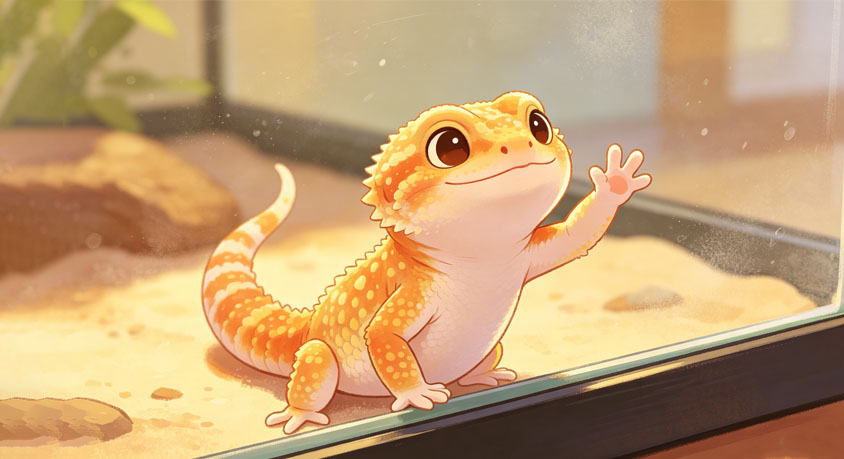
It is a quiet Tuesday afternoon, and you glance over at the terrarium. There sits Oliver, your Bearded Dragon, perched on his favorite driftwood. Slowly, he lifts one front leg and circles it through the air in a deliberate, rhythmic motion—almost like a tiny shipwrecked sailor waving at a passing boat. It is a gesture so human-like that it tugs at your heartstrings, but as he continues to stare at the glass with those ancient, golden eyes, you begin to wonder: Is he saying hello, or is he trapped in a cycle of stress you can’t see?
E.g. :When your leopard gecko licks its own eyeball: a clean or a corneal cry?
In the world of exotic pet care, these "micro-gestures" are often misinterpreted. We see a "wave" and project our human need for connection onto it, but for a reptile, this movement is a profound piece of evolutionary code that demands our empathy and understanding.
When we think of pet communication, we usually listen for a bark or a purr. However, Bearded Dragons communicate through a sophisticated silent language. The arm wave, or "circumduction," is primarily a submissive signal. In the wild, it tells a larger dragon, "I see you, and I am not a threat."
If your dragon is waving at the glass in a solitary tank, they aren't necessarily "greeting" you. Often, they are seeing their own reflection or a shadow and are trying to appease what they perceive as another dragon. Challenging the traditional view that reptiles are "unemotional" allows us to see that they are, in fact, highly sensitive to their visual environment.
Another common sight for owners is "glass surfing"—when a dragon stands on its hind legs and paws frantically at the glass. Many people mistake this for a desire to "play" or come out. While it can sometimes mean they want to explore, it is frequently a sign that their environment feels too small or their thermal gradients are off.
There is a persistent myth that reptiles are "set it and forget it" pets. This misconception often leads to "sensory boredom." If your dragon is glass surfing, it’s time to look at their world through their eyes. Are they seeing a reflection that scares them? Is the terrarium a barren glass box? Understanding that their mental well-being is as vital as their physical health changes the way we approach exotic pet care.
To heal the anxiety of a captive reptile, we must move beyond the basics of heat and light. We need to create a "sensory landscape." This is where the right pet supplies become tools for psychological comfort rather than just hardware.
Adding visual barriers, like non-reflective backgrounds, can instantly stop the stress of "reflection-fighting." Providing varied textures—rough slate for filing nails and soft, safe mossy hides for resting—gives them a sense of autonomy. When a dragon feels they have choices in their environment, their stress levels drop, and those frantic waves often turn into calm, observant basking.
Bonding with a Bearded Dragon isn't about cuddles in the way we bond with a kitten. It is about "passive interaction." It’s about sitting near their enclosure while you read, letting them habituate to your presence without the pressure of being handled.
We often feel a sense of failure if our exotic pet doesn't seem "excited" to see us. But in the world of the dragon, the ultimate sign of love is actually "relaxed indifference." If your dragon closes its eyes when you are near or continues to bask peacefully while you move around the room, you have achieved a high level of trust. You have become a safe part of their horizon.
Living with a Bearded Dragon invites us to slow down. Their lives are measured in long basking sessions and slow, calculated movements. When we stop looking for "dog-like" reactions and start respecting their reptilian stoicism, we find a unique kind of zen.
By attending to their silent signals and adjusting their world with the right tools and a compassionate heart, we transform from "keepers" into true companions. Your dragon may not bark when you come home, but in the quiet stillness of a well-balanced habitat, their comfort is the most rewarding conversation you’ll ever have.