6 AM screaming from the bird room – your parrot isn't being chatty.
- Quick Tags: parrot screaming problem, bird separation anxiety, parrot enrichment ideas, quiet parrot training
- Editor: Editorial Team
- Updated: Apr,30,2026
- Views: 390.1k









You wake to a screech. Then another. Your African grey, Paco, is hanging upside down from his cage top, screaming at full volume. You shuffle into the room and shush him. He pauses, tilts his head, then screams louder.
E.g. :Why Is Your Parrot Pulling Its Feathers?
You feel exhausted. Is he just a loud bird?
That 6 AM scream is not chattiness. It is not “talking back.” It is a distress call your parrot has learned works. And the way you respond right now is probably making it worse.
Parrots scream in the wild to locate their flock. In your home, you are the flock. When Paco screams and you appear, you have just taught him: screaming brings his human back. Even negative attention – yelling, running in, covering the cage – is still attention. To a flock animal, any response is better than silence.
One of my clients, Derek, had a cockatoo who screamed every morning at dawn. Derek would rush in, whisper “quiet,” and leave. The bird screamed louder. We changed the rule: no reaction for the first three screams of the day. Derek waited behind the door. When Paco paused for two seconds, Derek walked in calmly, gave a high-value treat, then sat nearby without eye contact. Within two weeks, the screaming dropped from 45 minutes to two short vocalizations.
Never respond while your bird is actively screaming. Wait for a break – even one second – then enter. You are rewarding the silence, not the scream.
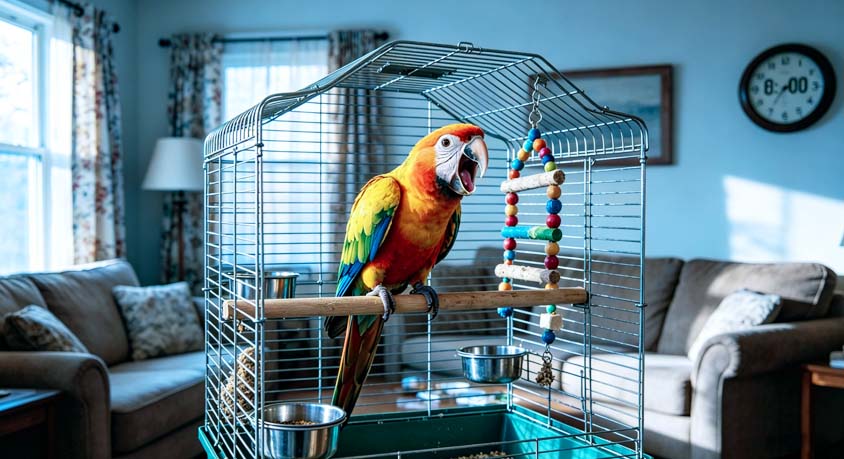
Many owners throw a cover over the cage to stop screaming. This works temporarily but increases anxiety long-term. A covered bird cannot see potential threats or flock members. For an already anxious parrot, sudden darkness is terrifying, not calming.
Use a breathable, light-blocking cover only on part of the cage – leaving the front or side open. This creates a secure retreat without total isolation. Pair it with a consistent bedtime and wake-up time (10-12 hours of dark sleep). Many screaming problems are simply sleep deprivation in disguise.
A parrot with nothing to do will scream. They are as intelligent as a toddler. Hours of empty cage time is torture. But more plastic toys won’t fix it. Parrots need destructible, replaceable foraging opportunities – things they can shred, tear, and destroy.
Offer at least three foraging activities per day. A foraging wheel filled with nuts and paper strips. A cardboard box stuffed with crinkle paper and a single sunflower seed. A paper bag tied to the cage bars. Cheap, disposable, and essential. Derek started hiding Paco’s entire breakfast in rolled paper cones. Morning screaming dropped by 70% in three days.
Some parrots scream the moment you leave the room. This is not manipulation – it is genuine panic. These birds were often hand-raised without learning self-soothing as chicks.
Practice leaving the room for one second, then returning. Do this fifty times in a session. Gradually increase to two seconds, five seconds, ten seconds. Always return before the scream starts. You are teaching your bird that you always come back. This takes patience. It works.
A noise absorbing panel placed near the cage reduces the piercing quality of screams without stopping the behavior abruptly. This saves your sanity and prevents you from reacting with anger. Use it alongside a sleeper cage cover and a loud fan or white noise machine to mask triggers like outdoor birds or delivery trucks.
If screaming has been reinforced for years, try moving the cage to a new room for one week. The unfamiliar environment resets expectations. Start fresh with “no reaction to screams, reward quiet.” Many owners see improvement within days.
Derek now drinks his coffee while Paco softly mutters to himself. The morning scream is a single, short contact call – then quiet. Derek waits two seconds, walks in with a treat, and starts their day together.
Your parrot’s dawn screaming is not a personality flaw. It is a learned alarm clock that you accidentally built together. You can unbuild it – with patience, foraging, and a door you learn to wait behind.