Why Your Cat Meows at a Half-Full Bowl
- Quick Tags: Cat Feeding Habits, Feline Instincts, Whisker Fatigue, Cat Behavior Modification
- Editor: Chloe Jones
- Updated: Apr,28,2026
- Views: 216.3k





We’ve all been there. It’s 6:00 AM, and your cat is performing a dramatic symphony of meows, pacing around your ankles as if they haven't seen a calorie in weeks. You stumble to their bowl, only to find a perfectly respectable mound of kibble still sitting right there in the center. To your human eyes, the bowl is half-full; to your cat, it might as well be an empty desert. You shake the bowl to level the food, and suddenly, they purr and dig in.
E.g. :BirdTikTok Teaching Parrots to Swear? Linguists and Bird Trainers Sound the Alarm
This "refusal to eat the edges" is often laughed off as feline pickiness or a play for attention. But behind those demanding meows lies a fascinating biological intersection of sensory anatomy and ancestral survival that most owners completely overlook.
To understand why a half-full bowl is a problem, we have to talk about whiskers—or more scientifically, vibrissae. These aren't just long hairs; they are sophisticated sensory organs deeply embedded in a dense network of blood vessels and nerves. They are so sensitive they can detect minute changes in air currents to help a cat navigate in total darkness.
When a cat reaches into a deep, narrow bowl to eat the remaining bits at the bottom, their whiskers constantly brush against the sides. This creates a state of "sensory overload" known as whisker fatigue. Imagine trying to enjoy a meal while someone constantly tickles the inside of your ear with a feather—eventually, the discomfort outweighs the hunger.
Many owners feel frustrated, believing their cat is "training" them to provide fresh food. I want to offer a different perspective: Your cat isn't being a diva; they are experiencing physical overstimulation. By dismissing this as a behavioral quirk, we miss an opportunity to reduce their daily stress.
In the wild, a cat would never eat out of a deep hole. They consume prey on flat ground where their whiskers are free to move and their peripheral vision remains unobstructed. When we force them to dive into a deep ceramic bowl, we are inadvertently fighting against millions of years of evolution.
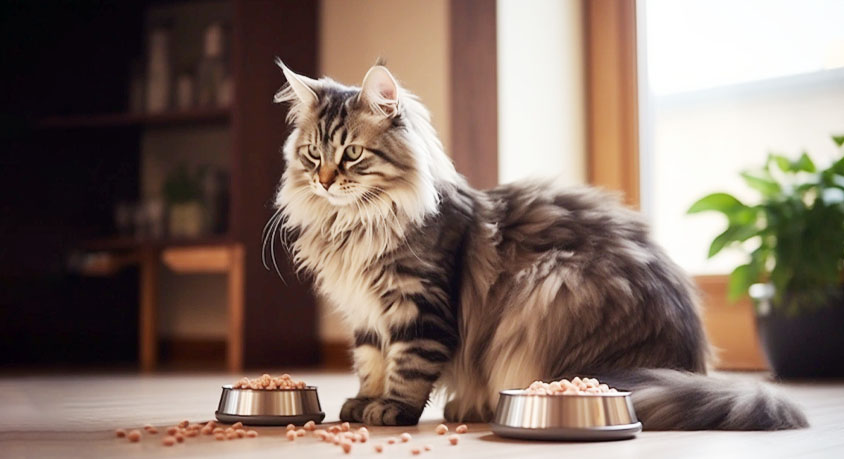
Sometimes, the meowing isn't about the food itself, but the delivery. In a modern home, pet supplies often prioritize convenience for the human over the psychological needs of the animal. A stationary bowl of food is "dead" prey.
If your cat stares at a full bowl and continues to cry, they might be seeking the dopamine hit that comes from the hunt.
Have you ever noticed your cat won't eat unless you are standing right there? This is known as "affection eating" or "social eating." In the wild, eating is a vulnerable time. By calling you to the bowl, your cat might be asking you to be their "lookout."
If your cat is a social eater, it’s a sign of immense trust, but it can also be a sign of environmental anxiety. Instead of just walking away, try spending a few moments pet-parenting through presence. Sit nearby, speak softly, and let them feel the security of the "colony." This builds a layer of emotional wellness that a simple pile of kibble can't provide.
Understanding the "why" behind the meow changes our emotional response from annoyance to empathy. We aren't just "servants" to our cats; we are the architects of their world. When we adjust the height, shape, and frequency of their meals, we aren't "giving in" to a spoiled pet—we are honoring the wild spirit that still lives inside our domestic companions.
Next time you see that half-full bowl, don't roll your eyes. Swap the dish, change the game, and watch how a little bit of biological insight can turn a frantic morning into a quiet, contented breakfast.