When your rabbit softly grinds his teeth – don't assume he's happy.
- Quick Tags: rabbit teeth grinding pain, rabbit body language, lagomorph health signs, rabbit stress symptoms
- Editor: Chloe Jones
- Updated: May,08,2026
- Views: 287.2k





You sit on the floor, stroking your rabbit’s back. He closes his eyes. A soft, quiet grinding sound comes from his jaw – chuk, chuk, chuk. You smile. He must be so content. Like a cat’s purr.
E.g. :Does Slow Blinking Hide Cat Inner Anxiety
Or so every online forum tells you.
That gentle tooth grinding has a twin. And the twin is a silent scream. Learning to tell them apart could save your rabbit’s life.
Rabbits do produce a soft, slow, barely audible tooth grind when they are deeply relaxed. Eyes half-closed, body melted into the floor. That is real contentment.
But stress and pain produce an almost identical sound. The difference is in the context and the volume.
Happy grinding is very quiet, intermittent, and paired with a limp body and slow blinking. Pain grinding is louder, more rhythmic, and comes with a hunched posture, half-closed but tense eyes, or teeth pressing against the floor. A rabbit in severe pain may also refuse treats or sit with his nose pressed into a corner.
One of my clients, Emma, brought me her rabbit, Mochi. She said he “purred” all night. He didn't. He was grinding from gastric stasis. He needed emergency vet care within hours. Emma had mistaken a distress signal for a happy sound.
Rabbits are prey animals. Showing weakness in the wild means death. So they evolved to mask every limp, every tooth ache, every bout of nausea. By the time a rabbit shows obvious signs – not eating, not moving – he is often hours from critical collapse.
Tooth grinding is one of the earliest pain signals. But because it mimics a happy sound, most owners ignore it until it’s too late.
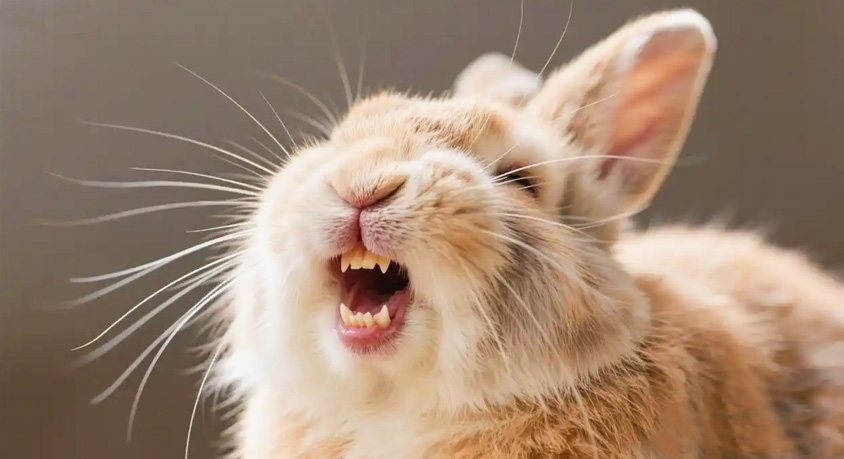
Offer your rabbit a small piece of his favorite herb (cilantro or basil). A happy rabbit will take it immediately, even while grinding softly. A rabbit in pain will ignore the treat or show nose-twitching hesitation. This test is free and takes five seconds. Use it every time you hear teeth rubbing together.
Grinding rarely comes alone. Watch for these quiet companions.
A painful rabbit sits with his front paws tucked inward, back slightly arched, and weight shifted onto his heels. He may press his belly against the floor. This is not loafing – it is bracing. Loafing is relaxed with soft eyes. Painful pressing comes with squinted, hard eyes and rapid, shallow breathing.
Gently feel your rabbit’s belly from the sides. A content rabbit may stop grinding briefly or ignore you. A painful rabbit will often grind louder when you apply pressure to the abdomen. That is not enjoyment. That is a cry for help.
Stop second-guessing yourself. If your rabbit is grinding and has not eaten or pooped in the last 4-6 hours, go to an emergency vet. GI stasis can kill in 24 hours. Bring a list of everything he ate and his normal poop size. Do not wait to “see if he gets better.”
If you cannot get to a vet immediately, keep your rabbit warm. Use a low-heat rice sock wrapped in a towel. Do not force feed unless a vet instructs you. Do not give human pain medication – it is often fatal to rabbits. Simply offer a bowl of warm water and a quiet, dark carrier.
Emma learned her lesson. Now she knows: Mochi’s real happy grind happens only when he flops on his side after a long run, eyes fully closed, body limp as a noodle. That sound is so quiet she has to put her ear next to his head. Any louder grind, and she runs the treat test.
Your rabbit’s gentle tooth grinding is not always a purr. It is a word with two opposite meanings. Learn the grammar of his body. That small skill will keep him hopping beside you for years to come.