Your cat rubs her face on your leg 12 times. That is not a hug.
- Quick Tags: cat bunting behavior, feline scent marking, cat affection signs, cat communication
- Editor: Chloe Jones
- Updated: Jun,22,2026
- Views: 312.9k



You stand at the kitchen counter. Your cat, Olive, weaves between your ankles. She presses her cheek against your calf. Once. Twice. She circles and does it again. You look down and smile. She loves you so much.
E.g. :When the Leash Snaps Taut: Is Your Dog Expressing More Than Just Urgency?
She does love you. But that is not what the rub means.
That face rub is not a hug. It is a property claim. Olive is not saying “you are wonderful.” She is saying “you are mine.”
Cats have scent glands on their cheeks, chin, forehead, and tail base. When Olive rubs her face on you, she deposits pheromones that are undetectable to your nose. She is not being affectionate. She is painting you as furniture.
A study on feline social behavior found that cats rub most on objects that are new, changed, or associated with other animals. Your leg after you come home from work? Covered in outside smells. Olive is erasing the coffee shop, the office chair, the neighbor’s cat. She is restoring her chemical map.
One of my clients, Tom, thought his cat, Jelly, was unusually loving. Jelly rubbed his legs twenty times every evening. Tom felt chosen. Then Tom adopted a second cat. Jelly stopped rubbing him entirely. She was not hurt. She no longer needed to claim him because the new cat was the threat. The rubbing was never about Tom. It was about the competition.
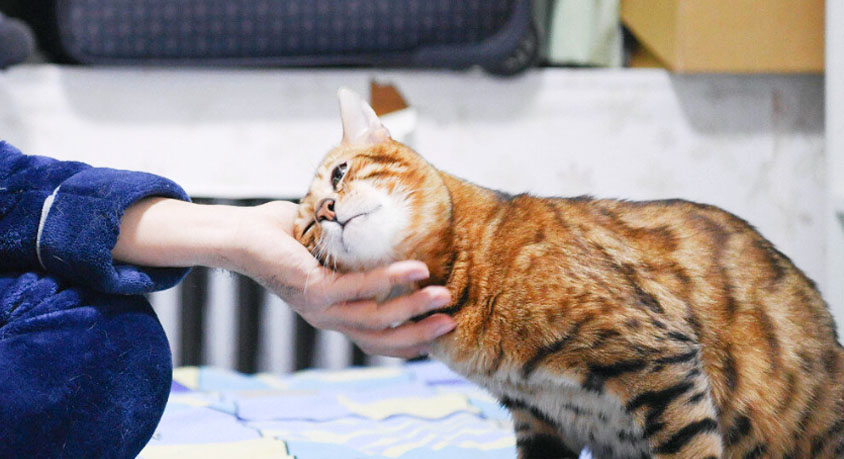
A head bunt (forehead pressing hard) is different. That involves the forehead glands and is often a genuine greeting. Cheek rubbing along a vertical surface (your leg) is territorial. Watch the body part. Forehead = hello. Cheek = mine.
Owners who mistake scent marking for love often miss early stress signals. A cat who rubs obsessively – dozens of times in a row, on every surface, including walls – may be anxious. Over-marking happens when a cat feels her territory is threatened. A new baby. A construction noise. A stray cat outside the window.
Tom noticed Jelly started rubbing the same spot on the couch for hours. He thought she loved that cushion. She had developed compulsive behavior from the stress of the new cat. A pheromone spray (synthetic feline facial pheromone) and extra vertical space (wall mounted scratcher) stopped the over-rubbing in two weeks.
A healthy cat rubs once or twice per interaction. She deposits her scent and moves on. A cat who repeats the same rub 10-12 times is not affectionate. She is anxious. She is trying to overwhelm competing smells. Listen to the number, not the gesture.
If your cat rubs your legs constantly, she may also be itchy. Ear mites, skin allergies, or a flea infestation cause facial rubbing that mimics bunting. Brush her cheeks and chin gently. If she leans into the brush hard, that is relief, not bonding. Check for black debris in her ears.
Redirect territorial rubbing to appropriate objects. A wall mounted scratcher at leg height gives Olive a place to claim that is not your trousers. Place it near your usual standing spots. Rub catnip on it. When she uses it, the leg rubbing often decreases.
Tom now knows that Jelly’s rubs mean “this is my house.” He still loves her. But he no longer misreads the message. He added a second litter box, a pheromone diffuser, and a cat tree by the window. Jelly rubs him twice now – once to claim, once to say hello. That is enough.
Your cat’s leg rub is not a rejection of love. It is just a different language. She loves you. She also owns you. Both can be true. Just stop calling it a hug.